Petals in the Noise
By Günther Kriel
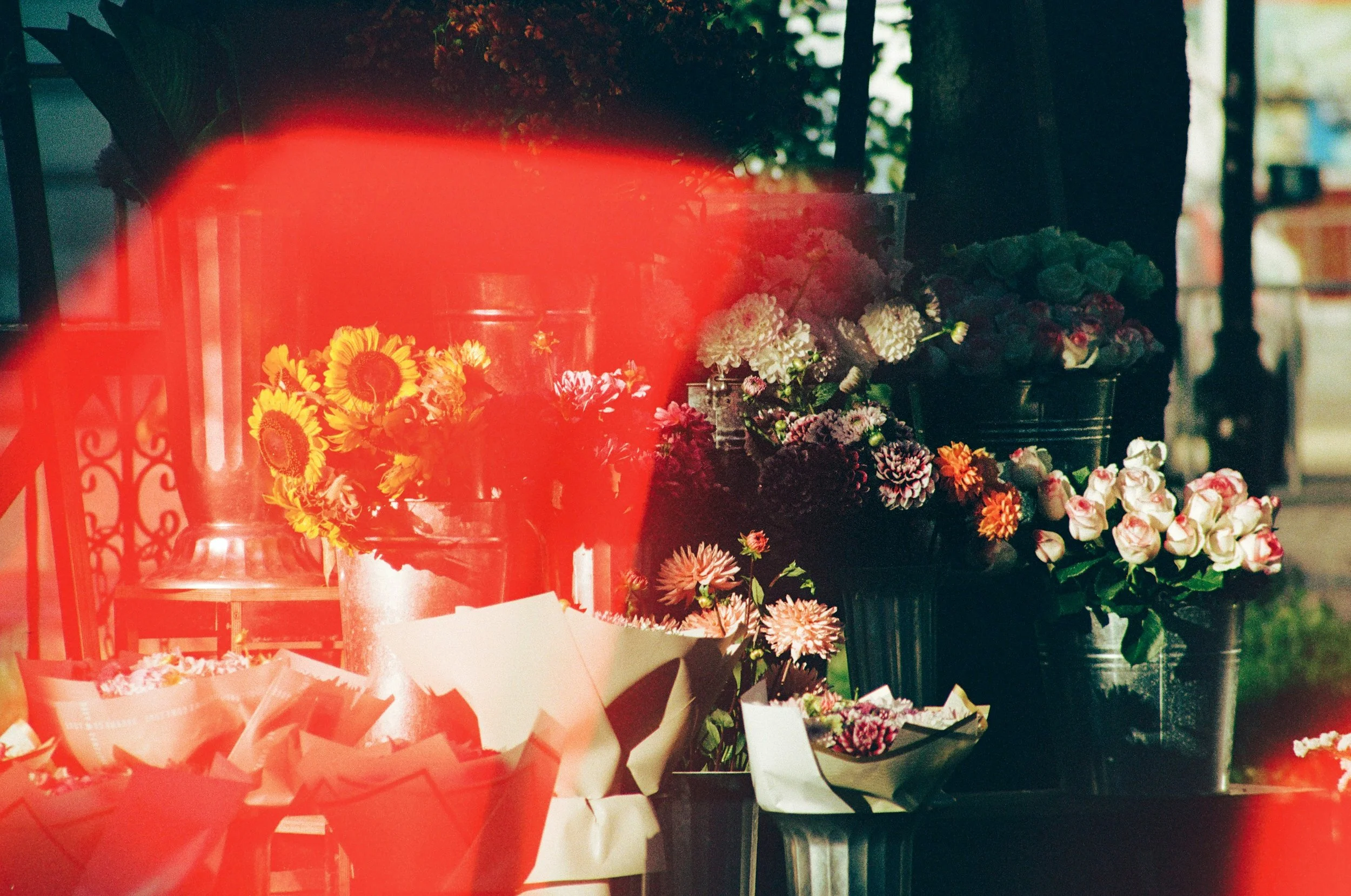
The buckets landed with a hollow thud against the ground. One by one she arranged them carefully under the arches, water sloshing, stems clattering. The flowers leaned together like tired bodies after a long journey — proteas, stargazer lilies, roses, carnations. A burst of vibrant colours against soulless concrete.
The air was damp from overnight watering, with the sweetness of crushed green leaves already mixing with city grit. Even before the sun was high, the smell of petrol crept into Adderley Street. MyCiti buses groaned at the lights, minibus taxis hooted in irritation. From the station, a thin voice echoed over tiny speakers: “Train to Bellville now boarding…”
She wiped her wet hands onto her apron, breath steaming into the soft cold. Her stall now looked ready. Her son bent down to tighten the ropes around the gazebo, his breath puffing out little clouds in the chill.
“Mummy, you need to get new rope, dis one’s almos klaar,” he said, tugging at the frayed twine.
“Ja, ek sal — when the money plays along,” she said, with a weary smile.
He checked the water in every bucket, straightened the petals that got caught in the move, and handed her a flask of tea, still steaming from the morning pour. “You good now?” he asked. She nodded, touching his arm briefly.
He gave her a kiss, grabbed his jacket, and walked towards the old white bakkie parked a few metres away. The engine coughed to life, backfiring once before settling into its rhythmic hum. As he pulled off, the sound faded into the morning’s growing noise—taxi gaatjies shouting, car brakes sighing, vendors calling out their wares.
“Flowers, beautiful flowers!” she called. Her voice joined the chorus of others along the row—women who’ve been here decades, some longer than she’s been alive. Their calls weaved together, layered like harmonies.
They have stood here for more than a century, these women of Adderley Street. Through rain, protest, and promises that never came; through mornings that began before dawn and ended in the dim light of streetlamps. Their mothers and grandmothers before them once sold bunches from woven baskets, voices rising above the tram bells and horse carts. Long before Apartheid drew its lines, they were already here. The Coloured women with calloused hands and sharp tongues, holding space in a city that often refused to see them. When the city changed its face, the buildings climbing higher and the pavements widening, the flowers stayed.
Many passed in awe of the picturesque blooms, but most didn’t know the history pressed into the layered dirt beneath the concrete: women who kept their families alive through segregation, strikes, drought, and through governments that came and went. Every sale carried that memory, wrapped in paper and twine, passed down like a prayer.
The first wave of people came fast: cleaners in uniforms, eyes still heavy, rushing towards buses behind the Golden Acre; office workers clutching paper coated coffee cups; students from nearby schools and colleges dragging backpacks and textbooks. They passed in rivers, some slowing to glance, most keeping their heads down — eyes fixed on the day ahead, like horses with blinkers. A young man broke off from a cluster of smokers outside the call centre building. Shirt already rumpled, cigarette dangling. He pointed to a bundle of roses.
“How much for one of this, auntie?”
“Fifteen, my sweetie.”
He grimaced. “Yoh, can’t you make it ten, please kanalah, for me?” he asked, tilting his head with a grin that was equal parts charm and cheek. His eyes widened in mock pleading, lips pursed like a puppy hoping for a treat — the kind of street performance she’s seen a hundred times before.
She lifted her chin. “You think that face works on me? Come, it’s fifteen.” She said, extending her palm, fingers curled slightly, the gesture firm and practiced— no nonsense, no discounts.
He laughed, before tilting his head away from her, drawing in a long pull from his cigarette. The tip flared auburn orange against the morning light. He let the smoke fill his lungs and flicked the stub to the ground, crushing it beneath his boot. A thick cloud escaped his lips, curling up into the air, vanishing into the distance.
“Gaan try dai’ by Checkers,” she added, voice softening just enough to show she wasn’t cruel. “Maybe they’ll fall for it there.”
Still grinning, he dug deep into his pockets and handed her a single note and coin. “Yoh, auntie is full of nonsense today neh.”
She took the money, folded it into her moon bag and nodded toward the buckets. “Go on, choose one before I charge you extra for talking so much.” He chuckled, stepping closer to pick a single stem — the biggest and brightest rose of course. As he turned back to his friends, she looked at them interacting and teasing him. She smirked and thought—men are still the same, just younger and poorer.
By mid-morning, the city had settled into its rhythm. Peanut sellers crowded the entrance to Company’s Garden, their plastic pouches strung up like trophies, waiting for passersby to buy a treat for the city’s spoiled squirrels. A woman hawking a community magazine called out between the blare of traffic, while a preacher on the train station steps shouted into the wind, his voice cracking against a wall of indifferent faces. A tourist couple stopped by her stall, wide-eyed at the riot of colours. The woman pointed at the proteas, camera already raised.
“Gaan jy koop, of net photos vat?” she said, not unkindly. They laughed, caught off guard, not understanding a word, before asking for the price.
“Seventy rand a stem,” she said, “and three hundred for a bouquet.”
They exchanged quick, nervous looks before the man smiled. “We’ll take the bouquet.”
She nodded, already reaching for the Proteas. As she gathered the stems, their phones came out — clicks and laughter mixing with the rustle of newspaper. She tied the bunch neatly, the ink bleeding faintly onto her fingers, then handed it over with a small smile. “Here you go, my darling.”
The man gave her three crisp hundred-rand notes, mumbled his thanks, and lingered a moment longer, still watching the sea of flowers before moving on.
When they left, the vendor at the next stall leaned over. “Raiyah, ek sien jy’s nou Instagram famous ne.”
“Ja,” she chuckled at the thought of it, her face everywhere on a stranger’s social media, “famous but still broke.”
The day thickened. The flowers were drooping in the heat, their heads heavy. She splashed water with her hands from a plastic jug, droplets sparkling before sliding down their stems onto the concrete and into the road.
Her stomach growled, a lion in its cage, as she reached for a small Rama bucket she had brought from home, its lid faintly greasy from use. Inside were two vetkoeks stuffed with mince, slightly warm and soft to the touch. She unwrapped one, the serviette paper turning translucent where the oil bled through. The smell of savoury mince, fried dough, and the faint notes of sweetness wrapped around her like a blanket. A light breeze slipped through Trafalgar Place, cool against her skin. She tore off a piece, chewed slowly, and took a sip of tea from her plastic flask mug; sweet, strong and still hot.
A group of students flowed past, laughing, their chatter tumbling between English and isiXhosa. One of the girls slowed down, eyeing the flowers. “Nathi, buy me some flowers, man,” she teased one of the boys. His friends erupted in laughter, egging him on. He pretended to not hear her, all bravado and no intention. She rolled her eyes and walked off, the others still joking behind her. Soraya smiled faintly and tore another bite from her vetkoek.
The man from the tuck shop down the road quickly arrived in front of her, a note in hand. Malawian, soft-spoken. “My sister, can you please help me with change for a fifty?”
She sighed while putting her lunch down and wiped her hands onto her apron, grease soaking into the fabric. Digging into her moon bag, coins still damp from flower-water, she smiled despite herself and said, “You must stop making me your piggy bank, hey.”
He grinned, nodding. “Ah my sister, thank you so much. God bless you,” he said, before rushing back to his store.
The afternoon dragged its feet with office workers beginning to trickle back from lunch, their shoes clicking against the tarred pavement. A woman bought a small bouquet for her desk. A man in a blue suit bought two bunches, with guilt written across his face. Flowers of lies, she thought, but she still wrapped them with care.
By four, the peak hour had arrived with commuters rushing to catch their taxis, buses and trains. The flower market becomes a blur of hands and voices, petals and coins. The smell of blooms still rising sharp and sweet against the sweat of daily grind and exhaust fumes.
An older man walked by through the rows, catching a short cut to his destination. “Boss, buy something for your vrou!” she called out, her voice slicing through the din. He slowed down, laughed and looked around. “Sorry auntie, not today.” Then quickly disappeared.
As the day began to slip and the sun started saying its byes, she started folding in for a close. One by one, the other vendors packed up, stacking buckets, tipping out water that ran in little rivers across the pavement. Petals floated, bruised and torn, towards the gutters. She gathered the leftover flowers—some still bright, others wilted—and tied them into bundles. Her apron damp, her hands stained, and her aching shoulders were the evidence of a long day’s work.
The city didn’t slow—MyCiti buses still roared, the train station still called out departures, and minibus taxis still hooted in chaos—but she stepped back from it all. For a moment, she looked down Adderley Street: lights started glowing, trees shifted in the wisp, people spilled in every direction.
Her day was done; her son would be there soon. She set everything down beside her chair, stretching her back as the last light slipped between the buildings. The city softened around her, leaving the faint smell of green and damp as her shadow.
Another day, another handful of petals offered to a city that never really saw her — yet she kept showing up, blooming in every way she could.
Günther Kriel is a South African writer and multidisciplinary designer based in Cape Town. He is the founder of Rueko Studio, a design studio which specialises in graphic design, web design, and legal design. A 2025 CANEX Creative Writing Workshop alumnus, Günther is working on his debut novel. His writing explores themes of identity, queerness, memory, and marginalisation, drawing on personal experiences and the complex histories of people of colour on the Cape Flats. He is also currently completing a Bachelor of Arts in Communication Science and Psychology through the University of South Africa.
- All rights to this story remain with the author. Please do not repost or reproduce this material without permission.
Did you enjoy this story? Drop a comment below!