Bucket List
By Uduak-Abasi Ekong
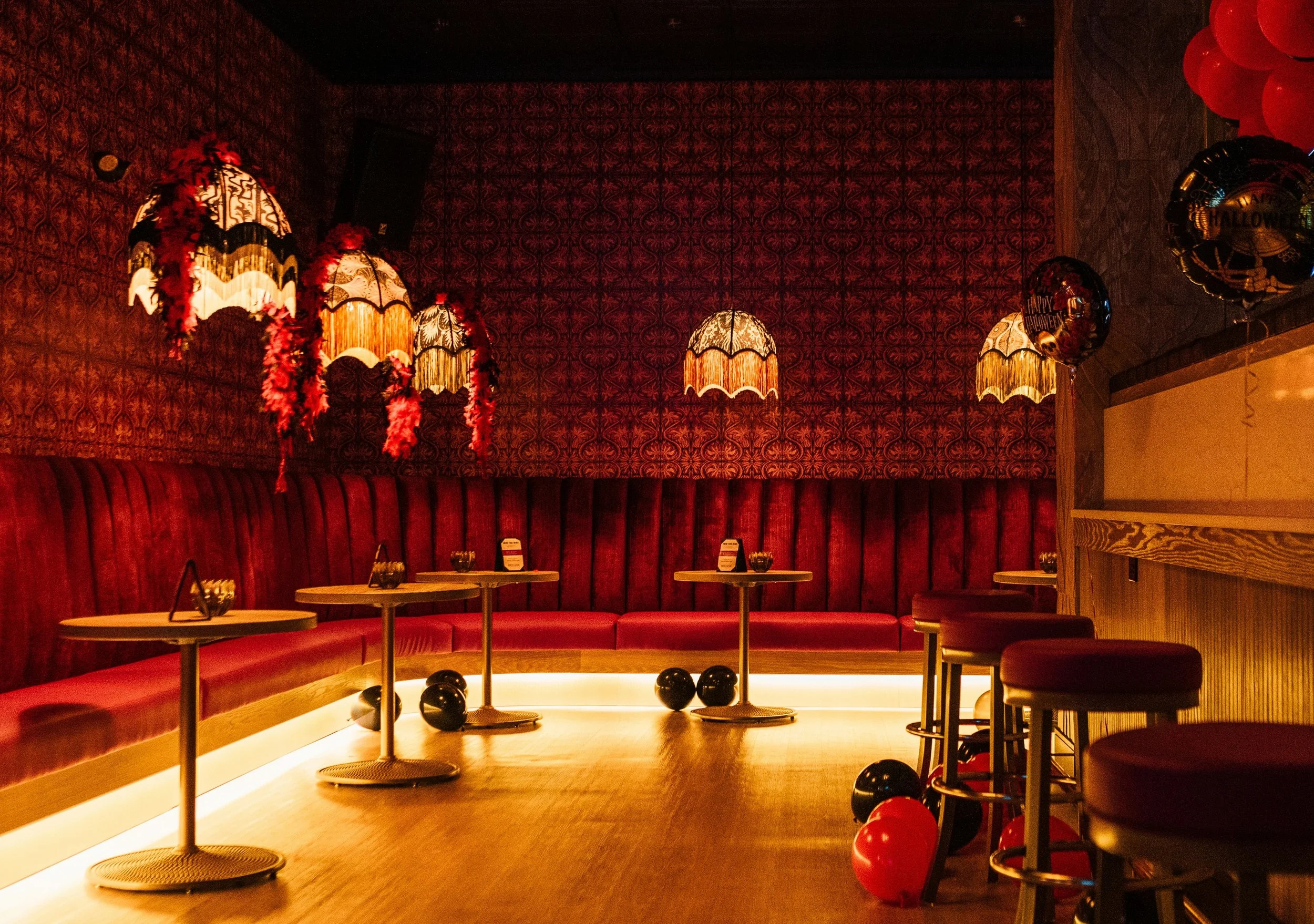
My mother folds her arms across her chest as she watches the stripper – a man with oiled biceps and the confident emptiness of a Nollywood villain – tear off his Ankara trousers with a flourish, revealing pink, flowery lace thongs. The kind that makes you wonder what he was thinking, and then what you were thinking. I look away, not at the women clapping too enthusiastically or those leaning into the spectacle, but at the air conditioner in the corner. It drips steadily, forming a puddle in the cracks between the grey tiles. I cannot look at my mother. She has not said a word since the show began.
She usually says I don’t think. She’s been saying it for years, like it’s a diagnosis. When I ate sand, poked sockets with a spoon, fell asleep under the car, and climbed to the top of our water tank.
‘Your problem is that you don’t think. You behave as if there’s fufu in your head,’ she’d say.
But I do think, that’s the problem. I just always believe what I’m thinking is a good idea. Which is how we ended up here, fulfilling item two on the list. Visit Second Base Lounge came from scrolling through social media, looking for ‘fun things to do with your almost sixty-five-year old mother.’ The photos online showed plush chairs, soft lighting, and peppered chicken on glossy plates. There was nothing warning that Tuesday night was stripper night, that a man with unevenly shaved pubes would grind his hips directly into my mother’s eyeline.
My mother picks up her bottle of Amstel Malt and drinks it directly. The sight hits me like a slap – my mother, placing a bottle on her lips.
‘Do you know how many germs are on this bottle?’ she used to ask, wrinkling her nose whenever I drank directly from a bottle. She always kept perfumed pink serviettes in her bag and with them, wiped the necks of even sealed water bottles with the caution of a chemist handling acid. She’d also wipe the glass she’d pour the drink into. If there was no serviette, no matter how thirsty she was, she wouldn’t drink at all.
Tonight, she didn’t use a serviette. I don’t think she even has one in her bag anymore. It’s like watching a queen walk barefoot on gravel.
‘So, what’s next on this your list?’ she asks, tilting her head towards the phone in my hand. There’s no judgment in her voice, at least not the kind you can catch with your bare hands. Just a gentle, terrifying calm that’s polite enough to peel the skin off your bones.
‘Erm…going to church,’ I say, flipping through my Notes app like it’s a test I forgot to study for. That’s a lie. The next item is Karaoke at Hotties Lounge, but after this, that might as well be a death wish.
Eyes follow us as we exit and I can almost feel their laughter even if no one’s bold enough to voice it. I don’t blame them. It took a full hour to try and convince my mother to wear a pair of jeans and a shirt and she settled for the worst of both—a jean skirt that fell to her ankles and a crisp white shirt that shone in the lounge’s dim light.
A few days ago, I never thought we’d be here. I was meant to come home, play the good daughter – hug relatives whose names I’ve forgotten, sit through church, ask polite questions about village land I’ll never inherit, answer questions on when I’d bring home a husband – and return to London after five days. A quick dash in and out of Uyo.
Then I found something in my mother’s room yesterday, folded between her old prayer books. And suddenly, I needed to do something. Somehow, that became a bucket list.
‘What’s a bucket list?’ she asked when I first suggested it. She was outside on the low wooden stool, knitting something unidentifiable with pink yarn. Her third hobby in three days. First, she tried baking meat pies but gave up because ‘meat pie will not satisfy you like garri and soup. What’s the point?’ Then, she tried Korean dramas but gave up before episode two because ‘It’s fake sef. What’s the point?’
‘A bucket list is like….you know….things we can do before I go back,’ I mumbled.
‘But you’re going back next tomorrow,’
‘I know, but it’s still enough time to change things…erm, do things,’
My voice snagged and I pretended to dust something off my jeans. There was no point explaining what a bucket list really was, not when neither of us were dying. Not in the traditional sense, at least.
But do I think? No.
‘I don’t want to do anything,’ she said, looking down.
‘Mummy, just think of something. Anything you’ve always wanted to try. It doesn’t have to be big,’ I handed her my phone.
‘I don’t have time for this,’ she said, needles clicking, yarn looping. These days, she didn’t have time for anything, not rest, not herself. She cooked, she cleaned, she cared for my father who could no longer lift a finger, literally.
‘Please,’ I said, holding out the phone like it was a peace offering. I thought of the letter, of her small, neat handwriting conveying words I never thought she could write, the way it ended, not with a goodbye but a full stop, and a cold shiver ran under my skin.
She sighed, took the phone, and tapped for a few seconds before handing it back.
It read, ‘breathe.’
Now, in the car, on our way to church, she takes a deep breath, her right hand dangling out the window like mine used to as a child. I stare at the spots on her hand. Each one tells a story, the time I spilled hot oil on her while frying yams, the time my father grabbed her wrist too hard, the time my brother slammed a car door on them.
Watching the wind tug at her hand reminds me of my childhood rides to the village. My sister, Abasiama, would fall asleep before we left the compound. My brother, Kene, would stage superhero battles on the dashboard. I would put my hand out the window, letting them fly in the rushing wind, till my mother slapped them back inside.
‘Dara! Put your hand inside! If a car hits your hand, nko? Your problem is that you don’t think!’ she’d say, glaring at me through the side mirror, eyes full of warning and love. That was how love sounded in our house, like a threat.
Now, I want to repeat her words to her jokingly. But I know she won’t laugh. I haven’t heard my mother laugh in years.
We pull into the church compound and I park beside the gate, where boys with wheelbarrows sell snacks and bicycles hold coolers of melting ice cream. The church building looks tired, yellow paint peeling like old scabs. My mother stands beneath the mango tree the pastor once called possessed, and forbade anyone from even glancing at. She looks at the church like it’s an old friend who betrayed her.
A woman by the pillar spots us and runs over. I don’t remember her name but she used to lead the women’s fellowship with my mother every Tuesday.
‘Sister Cecilia! Long time!’ She pulls my mother into a hug.
My mother gives that thin, social smile she keeps for occasions that demand a smile when she has none to give. I search her face for something more, a flicker of the woman who used to hum choruses while sweeping the church, but there’s nothing.
‘We’ve been praying for Brother Patrick. How is he?’
‘He’s the same,’ my mother says.
‘God will heal him,’ the woman says and my mother doesn’t even say ‘Amen.’
The woman turns to me ‘Ahn ahn, Daramfon, is this you? How is UK?’
I mumble the expected replies – London is fine, work is good, yes, still single – but my eyes are on my mother. She doesn’t go inside, not even to greet the choir members she once sang with. She just stands, hands clasped behind her back, staring at the door. Then, without a word, she turns and walks back to the car.
I leave the woman mid-sentence and follow. My mother sits in the car, arms folded, eyes straight ahead.
‘You didn’t even go inside,’ I say as I open the door.
‘I have to go and make soup for your father. You know he only eats fresh soup,’ she says, not blinking.
‘Daddy will be fine with soup from the freezer like the rest of us. I’ll tell Mfon to warm it for him,’ I say, getting in.
‘No, your father has eaten only fresh soup for thirty years,’ she fastens her seatbelt. ‘We’ll continue your list tomorrow.’
At home, she looks like a different person while cooking. The way she digs out unlabelled freezer bags of pepper and crayfish, clangs every pot she lifts, grabs hot lids with bare hands, pulls at the meat, keeps her eyes wide open while cutting onions. Even Mfon, the maid, ducks when she’s near her. This isn’t cooking, it is exorcism.
She’s been doing this for thirty years and I’ve been watching for twenty-seven. But now, I see it. The fine lines around her mouth, the permanent curve in her shoulders, her face drawn not by age, but by exhaustion, her hands moving with a rhythm of half rage, half duty. Thirty years of feeding a man who, even at his strongest, wouldn’t lift a kettle if it blocked his path. A man who shouted at her over rice grains on the floor, who reminded her, regularly, that the house was his, the cars his, the money his, and he could survive without her. A man who never once thanked her, even when she handed him something.
In the evening, I pass their bedroom. The door still has those small hole termites carved years ago. As children, Abasiama and I used it to peek inside, checking if our father was home before sneaking in to watch TV. Their room and Kene’s had satellite channels. Ours only had NTA. Now, through the same hole, I see her feeding him. She scoops a small ball of garri laced with Afang soup and places it in his mouth. He chews slowly, his head trembling, eyes lost. He looks nothing like the man who once roared when we were noisy, whose presence filled rooms like smoke. Now, he is a whisper. I turn away. The image tastes like bile.
I’ve only been able to go in their room twice since I arrived on Monday. First, to greet my father. He hugged me tight, told me seeing me made him feel cured, listened to me complain about London and how I missed Uyo mangoes. The second time, this morning, to thank him for the mangoes he’d sent Mfon to get me.
I head to the living room, mango in hand as I go through the bookshelf that shaped my childhood. I run a hand along the spine of The Art of War, which I read too early, and the Scholastic Children’s Dictionary, where an aardvark illustration haunted my dreams for weeks. Now, the shelf is soft with termites and plastered with obituaries.
I pull out one, it’s for Agnes Ekpo. Aunty Agnes, we used to call her. Her once-vibrant face is now printed in grayscale, beneath ‘Adieu’ and ‘Survived by.’ I didn’t even know she had died. My mother last mentioned her months ago, saying she had ovarian cancer, her voice tinged with a strange softness.
‘I thought you didn’t even like her,’ I’d said, not thinking.
They had been inseparable since meeting at NYSC camp in Ede. They went to the market together, cooked for each other’s events, sat on plastic chairs on the veranda eating groundnuts from bottles and drinking Coke from a jug. Aunty Agnes sewed all our clothes, always loyal to my mother’s style choices, even refusing to make Abasiama a gown with a daring neckline, and reporting her attempt. One day, while we were at Aunty Agnes’ shop waiting for our Christmas dress to be sewn, she reported something my mother was better off not knowing.
‘I saw your jeep in front of Avon Hotel on Saturday.’
‘It wasn’t our jeep,’ my mother said.
‘But I know your plate number. I even saw your husband with…’
‘I said, it was not our car,’ my mother said in a tone of finality.
After that, their friendship died, quietly. Aunty Agnes still visited, but my mother always had an excuse – Tell her I’m sleeping, Tell her I’ve gone out, Tell her I’m sick – till eventually, she stopped coming. Not long after, my father started taking taxis more often even when the car worked fine. That’s why Abasiama and I had to start peeking through the hole to know when he was really home.
Tonight, I lay on my old bed and watch the ceiling fan whir as I recall Abasiama’s presence. By now, she would have tuned into Dial my heart on the radio while we deliberated people’s romantic relationships. We would have snuck into the kitchen and gotten iced sachet water from the freezer which we’d chew on like popsicles. But, we were children then, and if Abasiama was here now, she probably wouldn’t indulge.
My mother enters, breaking the memory. She frowns at the fan and lowers its speed before leaning against the doorframe. Some habits never change.
‘Are you pregnant?’ she asks.
‘No,’ I laugh dryly.
‘This is your first time coming here since you went to UK and you’re talking about basin list,’
‘Bucket list,’
‘Is everything okay?’
I tell her half the truth. I got a surprise promotion and didn’t want to wait for Christmas because Daddy’s condition scared me. I wanted to see him as soon as possible. I tell her the bucket list came from trying to make up for the five years I was away. I don’t mention the folded paper I found.
‘Tomorrow, let’s go to my village,’ she says, before leaving my room.
It’s not on the list, but I’m glad she wants to do something. Anything. Even if it’s a three-hour drive.
The village roads are just as I remember, dusty and full of potholes. We pass familiar sights, the groundnut sellers at the roundabout, the bush clearings where my father used to stop so we could pee, the spot Kene threw out my novel and I was scolded for hitting him. At the family house, we’re greeted by relatives I don’t know. The ones I loved, the uncle who plucked guavas for me, the aunt who served food on metal trays, the cousins who made sure my mother never lifted a finger, are all dead.
My mother heads straight to the backyard and kneels at her mother’s grave. My grandmother died before I was born, but I know her through stories. A sharp-tongued woman who once held the village chief’s wrist mid-slap. When Abasiama and I were being stubborn, my father would say we had her spirit, in a tone of disdain.
My grandmother also fought for my mother’s education because my grandfather believed it was a waste of money. When she died while my mother was writing WAEC, he pulled funding and told my mother to find a husband. But she got a scholarship to the University of Calabar. He almost didn’t let her go, needing someone to manage the house. She was the last child and had two older brothers.
‘Maybe Papa was right,’ I once heard my mother whisper, staring at her framed degree gathering dust in the living room. I didn’t know what she meant then. I do now.
My mother whispers prayers and lays flowers on her mother’s grave before she leaves. She doesn’t even glance at her father’s, though it’s right beside it.
On the way back, she flips through old photo albums she took. Each photo is signed Cecilia Ufot in blue ink, dated in the corner. She pauses at one, her in art school. She was accepted after finishing university but got pregnant with Abasiama and married my father..
‘It’s strange seeing another name on your pictures,’ I say, before I can stop myself.
‘That’s not another name. That’s my name.’
‘I know, it’s just… I’ve always known you as ‘Mrs Cecilia Nyong.’’
‘I’ll always be Cecilia Ufot,’ she says.
I bite my tongue. My problem truly is that I don’t think.
‘When you get married, remain Daramfon Nyong,’ she says, after a pause.
‘What?’ I nearly choke.
‘Don’t change your name for anybody. Even if the person is Dangote or Otedola.’
I blink. ‘Mummy, you argued with me when Aunty Rose was getting married. I said I didn’t see why she had to change her name. You told me that a family should have a united name.’
‘If he wants a united name, he can take your own or you people can pick a new one,’
‘That’s exactly what I said! And you said I don’t think.’
‘I don’t remember that. But I’m telling you now, don’t change your name. You were born Daramfon Nyong. Don’t let anybody take that from you,’ she says, rubbing the photo.
I stare at her, wondering who this woman in my passenger seat is. This stranger, so different from the woman who raised me. I thought the letter I found was the most shocking thing. But this change, this evolution, is just as jarring.
I consider calling Abasiama to tell her about it. She’s in America now, with her husband and two newborns. I tried to speak to her two days ago, after I found the letter. I was packing to return to London and remembered one of my mother’s earrings I liked. She was at the market, my father asleep, snoring through the house like an old generator. I opened her trunk, found the earrings, and spotted a piece of paper sticking out of her prayer book inside the jewelry box.
Curious, I pulled it out, expecting an old love letter. I smiled at the idea. My mother, having an affair at sixty-five. With who? The plantain seller by the church? An old university classmate? A widowed deacon with a nice smile?
But what I read dropped my jaw. I took photos of it, slid it back into place, and closed everything. I sat on the trunk for a few seconds, shaking. Then I went to my room and called Abasiama.
‘What is it?’ she said immediately. Her patience had thinned since the twins. Their arrival was a blessing, my parents called it a double portion. But now, her husband worked eighty-hour weeks, and she barely slept. There was always something: a fever, a rash, a bottle to sterilise, a midnight cry.
‘I found a letter in Mummy’s trunk,’
‘What kind of letter? Love letter?’ she asked, sharp as ever.
It wouldn’t have been the first. Years ago, we found one while exploring our mother’s village house. It was a few months after Kene was born. Everyone was fawning over the miracle boy who had finally arrived and Abasiama and I went exploring our mother’s old room. They were from Richie, the man she was supposed to marry. He was an Igbo man and my grandfather refused him, citing a single murder in Uyo as proof that ‘Igbo men kill their Ibibio wives.’
‘Our women cannot marry their men,’ my mother’s family said, but never the other way round. Who were you to tell men who they could or couldn’t marry?
We looked him up on Facebook. Richard Nnaemeka. He lived in Seoul and was married to a Korean woman. They had three children. I used to imagine myself as one of his mixed-race kids living in Korea, back when I didn’t know how DNA worked. I never thought about how my mother felt. Whether she would have been happier with him.
‘No, it wasn’t a love letter,’ I told Abasiama.
‘Then what was it? Open your mouth and talk,’ she snapped as the babies cried. I wondered how she’d handle it, call the pastor or call our mother to scream at her for wanting something she’d call wicked? It would probably make things worse.
‘Erm... it was actually a love letter,’ I lied.
‘Mtcheww. You’re unnecessarily dramatic. Why were you now doing as if it was a suicide note or something?’ Abasiama hissed and hung up. I didn’t even consider telling Kene. I just sat in my room and cried.
That afternoon, a few hours before my flight back, I take my mother to the studio for her birthday photoshoot. Her birthday is next week, and it used to be a day associated with cake, fried rice, canopies, and guests bearing gifts. Now, since the letter, it feels like an anxious countdown. Her phone rings while she’s going through the roll with the photographer. It’s Mfon, telling her my father wants to drink moringa, and only my mother can make it the way he likes. I want to scream until the roof splits open and someone, anyone, hears me.
Let her rest. Let her live. Let her breathe. But I don’t scream. I drive her home and watch through the hole as she helps him drink, steadying the cup so it doesn’t spill. In the kitchen, after I’m dressed and ready to leave, I try to bring up the letter, but I can’t. I ask about the bucket list instead.
‘Will you wait for me so we can finish it? We’ve only done like four things,’ I say.
She looks at me, long and hard.
‘When will you come back?’
‘I don’t know. I’ll have to check my holidays,’ I pause. ‘But, I can bring you to London and we can add more things to do there. Or even go to America, see Abasiama and the twins. We’ll make a list for every place.’
‘So this your list will not finish?’ she asks, rinsing the cup.
‘I don’t want it to,’ my voice cracks and she looks at me.
‘Hmmm, what about your father?’
‘Mummy, Kene is in this Uyo. After everything you and Daddy have done for him, why can’t he watch Daddy?’ I snap. Kene was the only one who went to a private school, only one my father bought a car for, only one had his own phone growing up, he should be here, helping.
‘It’s my duty,’ she says, calmly.
I sigh. ‘Okay, forget Kene. Erm…Abasiama and I will hire someone. In UK, people have carers. You don’t always have to be the one.’
She looks at me for a short while and finally nods slowly in defeat.
I spend my flight back thinking about what more I could have said. What I should have said. On her birthday, I send her a message because I’m too anxious to call. I text her all day, as if keeping her replying might keep her alive.
That night, I send one last message: Mummy, please don’t do it.
She doesn’t reply. Just taps ‘like.’
I cry all night. The next day, I call before the sun rises. When I hear her voice, I exhale so hard it hurts. She talks about the carers she’s considering for my father and we begin planning the London bucket list. For the first time, I let myself imagine it: my mother in front of Big Ben, her scarf blowing wildly. Standing in a museum, frowning at the art and saying it all looks like nonsense.
Still here.
Still alive.
Still my mother.
Uduak-Abasi Ekong is a Manchester-based Nigerian writer whose work appears in The Bournemouth Journal, Wensum Literary, Ojuju Magazine, Brittle Paper, and more. Her novel, Welcome Back Darling (a.k.a. A Kind of Resurrection) won the 2025 Exeter Novel Prize, was runner-up for the inaugural Hilary Mantel Prize for Fiction, and was shortlisted for the 2026 Women’s Prize Discoveries Award. Her fiction has also been shortlisted for the Merky New Writers’ Prize, Creative Future Writers’ Award, Oxford Flash Fiction Prize, and more. She is a 2026 SmokeLong Emerging Writer Fellow and a Faber Academy alumna.
- All rights to this story remain with the author. Please do not repost or reproduce this material without permission.
Did you enjoy this story? Drop a comment below!